
FACT
TPO and PVC are thermoplastic membranes whose seams can be heat-welded. EPDM is a thermoset synthetic rubber membrane and uses system-specific seam tapes or adhesives rather than thermoplastic heat welding.
TPO, PVC & EPDM: What the Material Data Tells Us
The first useful comparison is physical construction. Commercial single-ply membranes are manufactured in multiple thicknesses, allowing designers to select products according to system requirements rather than treating every membrane of the same chemistry as identical.
| Characteristic | TPO | PVC | EPDM |
|---|---|---|---|
| Material Family | Thermoplastic polyolefin | Polyvinyl chloride | Synthetic rubber |
| Common Nominal Thicknesses* | 45, 60, 80 mil | 50, 60, 80 mil | 45, 60, 75/90 mil |
| Seam Method | Heat welded | Heat welded | Tape/adhesive systems |
| Typical Reinforcement | Commonly reinforced | Commonly reinforced | Reinforced and non-reinforced products available |
*Nominal thickness offerings vary by manufacturer and product line. Specifications should always be verified for the exact roofing system being considered.
STATISTICAL SUMMARY
Common commercial specifications place these membranes broadly within an approximately 45–90 mil nominal thickness range, depending on membrane type and manufacturer. Thickness is useful specification data, but it should not be treated as a stand-alone predictor of roof lifespan.
Thickness, Seams and Performance Characteristics
A mil equals one-thousandth of an inch, so a 60-mil membrane has a nominal thickness of approximately 0.060 inch. Moving from 45 mil to 60 mil represents a nominal increase of about 33%, while moving from 60 mil to 80 mil represents another increase of roughly 33%. Those figures describe material thickness—not an equivalent percentage increase in durability or service life.
Seam construction creates another measurable distinction. TPO and PVC are thermoplastic materials, allowing installers to use controlled hot air to fuse overlapping sheets. EPDM cannot be heat-welded in the same manner and instead relies on compatible seam systems specified for the membrane.
| Performance Factor | TPO | PVC | EPDM |
|---|---|---|---|
| Heat-Weldable Seams | Yes | Yes | No |
| Highly Reflective White Options | Common | Common | Available in some assemblies; traditional membrane is black |
| Flexibility | Flexible | Flexible | High elasticity is a notable characteristic |
| Resistance to Certain Oils/Grease | Product-specific evaluation required | A notable advantage of many PVC systems | Exposure should be carefully evaluated |
FACT
Membrane thickness and chemistry provide useful comparison points, but the roof’s weakest details often determine whether water enters the building. Seams, flashing, penetrations, drains, perimeter conditions, and workmanship therefore require the same attention as membrane selection.
Reflectivity and Energy Performance
Roof surface temperature and solar reflectance have become important considerations for many commercial properties. Light-colored TPO and PVC products can reflect substantially more incoming solar energy than conventional dark roofing surfaces. However, exact reflectance values vary by product, age, testing method, and surface condition.
That distinction is important in Sacramento, where long periods of warm, sunny weather can make roof-surface characteristics relevant to building design. Reflective roofing may help reduce solar heat gain through the roof, but whole-building energy performance still depends heavily on insulation, HVAC efficiency, air leakage, occupancy patterns, and operating schedules.
STATISTICAL SUMMARY
Solar reflectance is measured on a scale from 0 to 1: a value of 0 represents essentially no reflected solar energy, while 1 represents complete reflection. Because actual values vary among products and as membranes weather, project specifications should use tested ratings for the exact membrane rather than a generic number assigned to TPO, PVC, or EPDM.
| Energy-Related Variable | What It Measures | Why It Matters |
|---|---|---|
| Solar Reflectance | Fraction of solar energy reflected by the surface | Influences solar heat absorbed at the roof surface |
| Thermal Emittance | Ability of a surface to release absorbed heat | Contributes to roof thermal behavior |
| Insulation R-Value | Resistance to conductive heat flow | A major component of roof thermal performance |
| Membrane Color | Surface characteristic influencing solar absorption | Can affect roof surface temperature |
For this reason, reflective membrane selection should be treated as one variable within a complete energy strategy. A highly reflective membrane installed over an assembly with inadequate insulation does not automatically create a high-performance building.
Installation, Maintenance and Lifecycle Considerations
Installation data alone cannot predict roof longevity. Attachment method, substrate preparation, seam quality, drainage, flashing, penetrations, rooftop traffic, severe weather, and preventive maintenance all influence how a system ages. Two roofs using nominally identical membranes can therefore produce different outcomes.
Maintenance frequency provides a more useful planning benchmark. Industry practice commonly supports inspecting commercial roofs at least twice per year, with additional evaluations after major storms or unusual rooftop activity. That translates into a baseline of approximately two scheduled condition reviews per year, plus event-driven inspections when circumstances justify them.
FACT BOX: MAINTENANCE BY THE NUMBERS
- 2: Common baseline number of scheduled roof inspections per year.
- 3: Major membrane families compared here—TPO, PVC, and EPDM.
- Multiple: Additional inspections may be appropriate after severe storms, construction activity, or rooftop equipment work.
- 1 complete system: Membrane, insulation, flashing, drainage, penetrations, and attachment must function together.
Commercial property owners seeking TPO, PVC & EPDM Roofing Experts in Sacramento should therefore expect recommendations to extend beyond membrane chemistry. Local climate, building operations, existing roof conditions, drainage, insulation requirements, and maintenance objectives should all influence the specification.
Matching the Data to Your Commercial Building
Measured characteristics become useful only when they are connected to actual building conditions. A warehouse prioritizing reflective roofing may evaluate TPO or PVC differently from a restaurant where grease exposure reaches the roof. A facility that places particular importance on membrane elasticity may have reasons to evaluate EPDM more closely.
| Project Condition | System to Evaluate | Data Point to Review |
|---|---|---|
| Reflective roof is a project priority | TPO / PVC | Tested solar reflectance and thermal emittance |
| Oil or grease exposure | PVC merits evaluation | Manufacturer chemical-resistance data |
| Flexibility is a major consideration | EPDM merits evaluation | Membrane physical properties and assembly design |
| Recurring leaks on existing roof | Do not select by membrane first | Moisture, drainage, substrate, and flashing assessment |
STATISTICAL SUMMARY
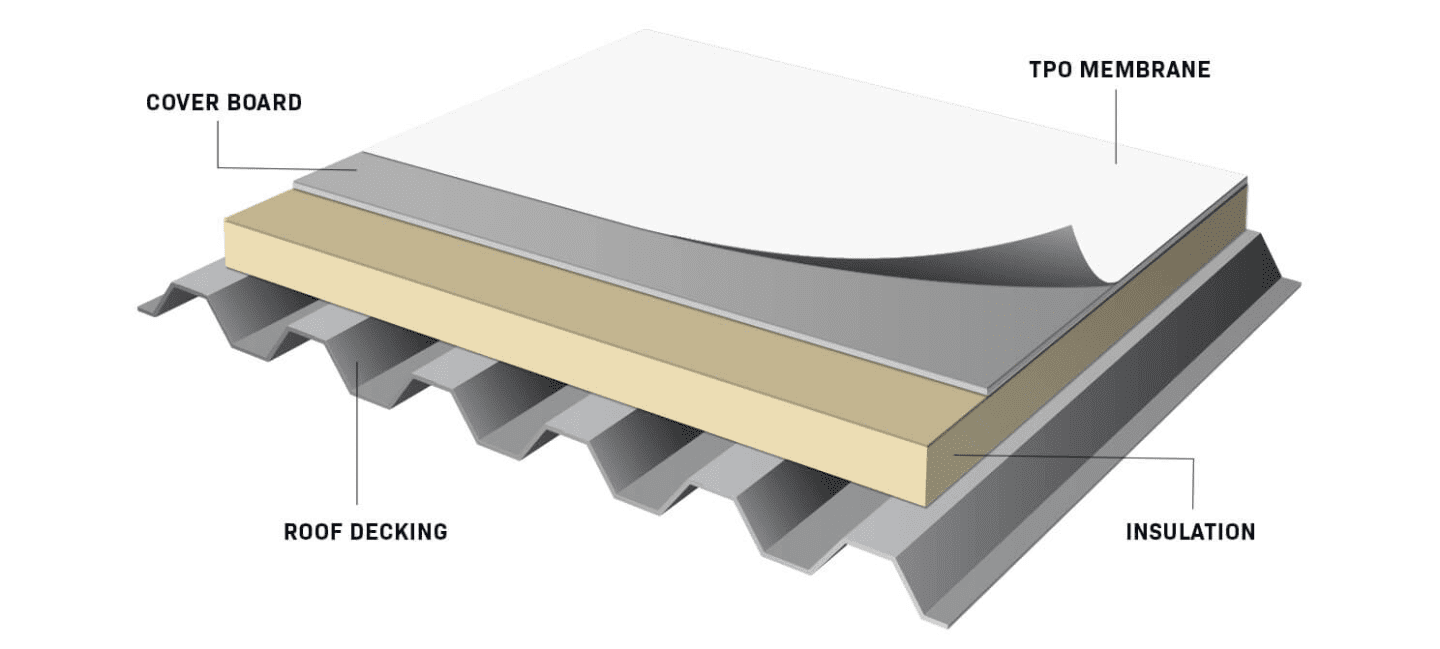
Three membrane types can produce dozens of possible roof assemblies once membrane thickness, insulation, attachment method, cover board, flashing, and other design variables are considered. Comparing only TPO vs. PVC vs. EPDM therefore captures just one layer of the roofing decision.
Making a Performance-Based Roofing Decision
The data does not identify a universal winner. TPO offers thermoplastic construction, heat-welded seams, and widely available reflective options. PVC shares thermoplastic seam technology while providing useful resistance characteristics for certain chemically demanding environments. EPDM contributes high flexibility and a long history in commercial low-slope roofing.
The strongest specification combines these measurable material characteristics with site-specific evidence. Inspect the existing assembly, determine drainage and insulation needs, identify rooftop exposures, review manufacturer data for the exact product, and establish how the roof will be maintained after installation.
For commercial property owners, that is the practical value of a data-driven approach: **numbers narrow the options, but building conditions determine the decision.** When product data, professional installation, and preventive maintenance are considered together, single-ply roofing becomes a system selected around measurable performance rather than assumptions.